This post is part of the Reading Writers of Color 2021 challenge hosted by Lonely Cryptid Media’s staff writer and editor, Dan Michael Fielding.
I’ve read a lot of books by white people. Like, a lot.
Most of these books were assigned to me in school and, later, at college and graduate school. When I was taught about the “canon” of great literature I was taught about white people (and specifically about white men). When I was learning the social theory that would shape my perspective as a Sociologist, I learned the thoughts and theories of white people, too.
I have a distinct memory of sitting in in a graduate seminar on Race and Ethnicity. We had just read Patricia Hill Collins’ Black Feminist Thought, and my world was rocked. Every word of her book had felt like a revelation. I said that I felt she was the most brilliant person I had read so far in grad school, and I wondered aloud why we didn’t start students off by reading her work.
Another student, also white like me, said that we couldn’t do that. We needed to start with the “foundational theorists” so we could “understand what Collins was responding to.” From this perspective, Collins’ work was unintelligible unless we first read, absorbed, and accepted the thoughts and perspectives of dead white men.
My experience as a student and a reader is a reflection of larger systems of racial oppression. Defining great works as primarily works written by white people is no accident of history. I won’t pretend that simply by reading a few books we can dismantle racism, but at least we can resist being complicit in the systemic racism of the publishing industry and in education.
To that end, I’m challenging myself–and you reading this–to commit to reading works by black, Indigenous, and people of color* this year.
I’ve designed this challenge with three goals in mind.
First, to introduce you to a variety of writers of color across different genres. There is no single genre this challenge favors, and the hope is you may stretch your comfort zone a bit and read something you wouldn’t normally seek out.
Second, to build skills in finding and recognizing authors of color. Because we are inundated by whiteness it becomes normalized to only pick up books written by white authors, but it doesn’t have to be this way. This isn’t a challenge that can be completed in a year, after which you can go back to uncritically reading whatever falls into your lap. Instead, I hope that through skill building you’ll be better able to recognize who is writing what you’re reading and what background and biases they may be bringing to the table.
Finally, to inspire you to read even more works by Black, Indigenous, and people of color beyond just the 12 books you will choose as part of the challenge. If you’re a voracious reader 12 may not seem like very many books at all in which case, great! We all have our favorite genres, and I encourage you to examine your own reading practices and commit to reading writers of color for every book this year. For those of us who may not have much time to read, or may not be well-practiced at reading, a book a month can be a big commitment. I encourage you to adjust the challenge to fit your circumstances. If committing to a book is not feasible consider instead committing to reading articles or short stories. Remember, too, that audio books totally count as books read!
Each month I will post a short guide explaining the goals of each challenge prompt with some options for books to choose from, but you’re never required to choose one of the books on my lists. My goal is to share my research with you and remove the barrier to entry during months when you may be too busy to spend time researching what to read ahead of time. I will tell you about my own picks and what I’ll be reading, and you can share books you know of in the comments of each post. Together, we can build a community of knowledge sharing.
Part of this challenge also asks you to write reviews for each book and post them somewhere notable. Strong reviews encourages new readers and can help get the books we read for this month into more hands. You can also follow the authors you read on social media and help boost their viewership.
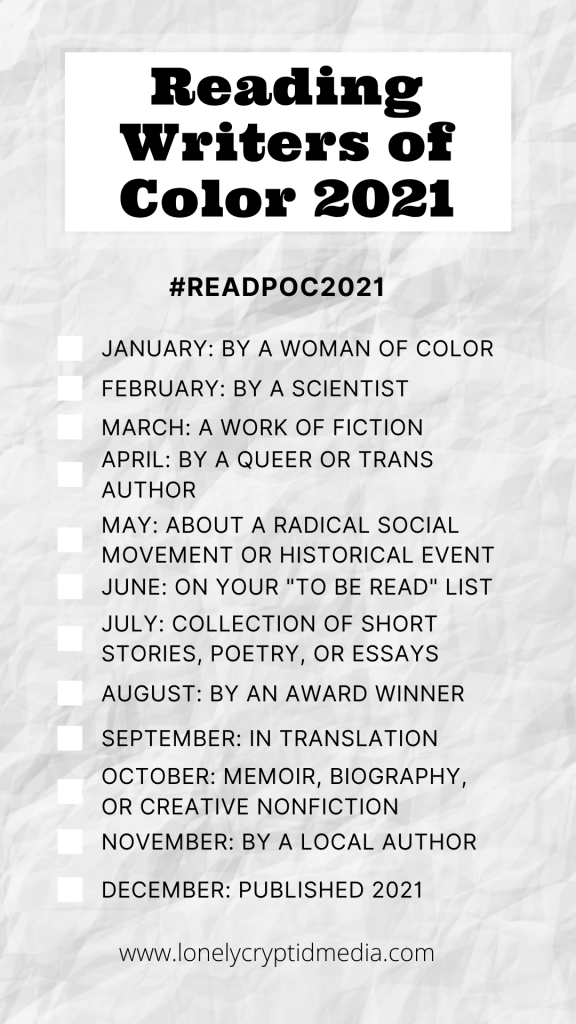
For the year 2021 read the work of Black, Indigenous, and people of color that fit the following prompts:
- January: By a woman of color
- February: By a scientist
- March: A work of fiction
- April: By a queer or trans author
- May: About a radical social movement or historical event
- June: On your “to be read” list
- July: Collection of short stories, poetry, or essays
- August: By an award winner
- September: In translation
- October: Memoir, biography, or creative nonfiction
- November: By a local author
- December: Published 2021
Which month looks most exciting for you? Which month are you most uncertain about?
Your first task? Make a public commitment to the challenge. You can post in the comments below and make a public statement on social media and/or to your friends and family. Making this commitment to centering the voices of racially marginalized authors in 2021 can help you hold yourself accountable.
If you’d like, you can share the image below in your public commitment and encourage others to join as well!
Let us know below how your public commitment went. Happy reading!
*A quick note on terminology: In the official challenge name I’ve used the term “writers of color” in part because it is general term that many people are aware of. But I recognize and honor that terminology changes, and currently the term BIPOC (Black, Indigenous, and people of color) may be a more useful concept to help center to voices of those most marginalized by processes of colonialism and anti-blackness. Therefore, I use both when describing the challenge. Whenever possible, I will use the specific racial identification of the individual authors when discussing their books.
 lonelycryptidmedia.com
Thanks for this challenge! I will give it a shot. October looks difficult for me. I am not a reader of memoirs or biographies. What is „creative“ non-fiction?
LikeLiked by 1 person
Thanks for joining in! Creative non fiction is anytime the author uses aspects of creative fiction writing to tell a non-fictional story. Things like narrative voice or lyrical descriptive language. So a textbook would be “non creative non fiction” but a story based on real events, but stylized or adjusted to make for an interesting story, would be “creative non fiction.” Hope this helps!
LikeLike
Hello! Creative non-fiction/literary memoirs are my favorite genre so if you don’t mind, I’d love to offer some recommendations!
Heavy: An American Memoir – Kiese Laymon (Black writer/my personal favorite of all time)
In the Dream House: A Memoir – Carmen Maria Machado (Queer Latina Writer)
Heart Berries – Terese Marie Mailhot (First Nation Canadian Writer)
How We Fight For Our Lives – Saeed Jones (Gay Black writer)
On Earth We’re Briefly Gorgeous – Ocean Vuong (Gay Vietnamese American writer) (technically a novel but considered to be semi-autobiographical)
Freshwater – Akwaeke Emezi (Non-binary Igbo and Tamil writer) (another novel based heavily on autobiographical material)
Hope this helps! Let me know if you read/enjoy any of these =)
– Caitlyn
LikeLike
One thing I love about this challenge is it lets me learn about a lot of wonderful books that are outside the usual genres I read. Thanks for sharing!
LikeLike
For a memoir, check out The Beauty in Breaking: A Memoir by Michele Harper. It was one of my favorite reads from last year.
LikeLike
Thanks for the recommendation!
LikeLike
I am currently listening to Becoming by Michelle Obama and contemplating her husband for the memoir prompt…
LikeLike
I want to join! I have been trying the past few years to expand my reading to include more BIPOC writers, but I can do better! Plus it’s more fun with company. 😁
LikeLike
Happy to have you! Excited to read along with you. 🙂
LikeLiked by 1 person
Thanks for the explanation, it helps!
LikeLiked by 1 person
Btw, I found your challenge through Habitica…
LikeLiked by 1 person
I am most excited about getting to discuss Their Eyes Were Watching God with my book group in April. Zora Neale Hurston was not queer or trans as far as I know, so I will read it in March for “A work of fiction.”
I am most uncertain about November: By a local author.
LikeLike
What a great pick! Yes, the local author month can be one of the most difficult. We often don’t know about the wonderful authors who are writing right under our noses. 🙂 A good place to start is with any local bookstores or your local library. Often local authors will do readings in the community, and your library or bookstore will know of them.
LikeLike
I think my local author will simply be a German one. I‘ll see if I can find someone from the South of Germany, Stuttgart or Munich…
LikeLike
Thank you for thwart challenge! I am really looking forward to this reading challenge even though reading is somewhat difficult for me to focus on lately. I used to read a ton.
Throughout the year, I will challenge myself to read some books which centre BIPOC joy and make sure not everything I read by a POC is about theory or racism. It is important to remember these voices have a range of things to share and express but in the past I have tended towards the heavy topics.
LikeLike
I love the plan to center joy! And I can relate to reading being more difficult. Remember that it’s totally fine to read something shorter or to listen to an audio book.
LikeLike
Very excited for this challenge! I’m taking a course on “diversity and social justice in higher education” for my doctoral program and our reading list includes bell hooks’ Teaching to Transgress and other works like How to be an Antiracist, White fragility, and Purpose of Power. As a white woman, I have a lot of ground to cover to educate myself on BIPOC scholarship related to higher education!
LikeLike
Sounds like an interesting class! It’s always great to be able to talk about what you’re reading with other students as well. You’ll have to let us know your recommendations as you work through the material. 🙂
LikeLike
Very excited for this challenge! I’m taking a course on “diversity and social justice in higher education” for my doctoral program and our reading list includes bell hooks’ Teaching to Transgress and other works like How to be an Antiracist, White fragility, and
LikeLike
It’s always good to be able to talk about what you’re reading with other students. Let us know your thoughts on what you’re reading!
LikeLike
This looks amazing! I’m just feeling particularly stupid as I’m not sure what is meant by “In Translation”. Most likely something obvious! Any advice would be appreciated! Thank you for this!
LikeLike
Hi Brenna! Basically, any book that has been translated from another language into a language you can read. The goal being to read the works of more international authors while also potentially tapping into genres and styles you may not often get a chance to read.
LikeLike
Thank you!
LikeLiked by 1 person
This sounds like a really good reading challenge! I can’t wait to get started. I have already started researching for each month to see what is out there. Thank you so much for sharing!
LikeLike
Glad you can join us, Anne!
LikeLike
I found your challenge on Habitica and I’m super excited to join! I’m Asian-American so I read a lot of Asian-American fiction already, but this year I want to branch out and actively seek out other perspectives as well.
LikeLike
Thanks for joining! Maybe you can recommend some good Asian-American authors and we can return the favor and recommend a few authors from other backgrounds. 🙂
LikeLike
This challenge is so necessary. Thank you for putting down your thoughts and helping us all read outside what we normally do. I’m trying to be more conscious in choosing books by more diverse authors and also on broader topics
LikeLiked by 1 person
Thabks for your kind words and for participating with us.
LikeLiked by 1 person
Can I use the 3 color block graphic at the top of the page too? I will link back to you.
LikeLike
Yep that’s fine as long as you include the link! Thanks for sharing the challenge.
LikeLiked by 1 person
Oh, excellent, good to kn ow! I thought about it, but didn‘t just want to use it.
I am making slow, but steady progress with Becoming by Michelle Obama. And I read some interesting articles about the acronyms POC and BIPOC and their merits and also sentiments against them and further shoehorning people by assigning labels.
LikeLike
February is going to be a tough one. I‘ve done some browsing online and haven‘t come up with much. What I posted to my blog were more memoirs than pop-science, which is what I would prefer. So I am looking forward to what you will come up with! 😏
LikeLike
I’ll be posting my write up tomorrow. I found 50 books to choose from but had a bit of difficulty as well, which I talk about in the post.
LikeLike
Thanks for putting this together, I’m really excited to start reading! I picked Everfair to start with 🙂
LikeLiked by 1 person
Great pick! Let us know what you think. 🙂
LikeLike
I am late to this but can start with February! I travel for work as a wildland firefighter both doing suppression and mitigation, so I can’t commit to all months to read a book, but I can try to load some articles onto my phone before I leave service. For the time being though, I am home and can commit to a book in February at least! I will try to get my family to participate!
LikeLike
It’s all good! Doing what you can is great. Thanks for participating. 🙂
LikeLike
Thank you for this challenge!! I’m excited to join in.
LikeLiked by 1 person
Thanks Altovise! 🙂
LikeLike
I am excited to join this challenge. I hope to rekindle my love of reading as I had been an avid reader in my younger years.
LikeLike
Thanks for this challenge and the push. I am joining it on Habitica, and I plan to make up the missed months as well.
LikeLiked by 1 person
Good luck with your reading and thanks for joining!
LikeLike
I joined it on Habitica as well! 😊
LikeLike
I just found the March entry on Habitica, too! I’ve been making a commitment already to reading more BIPOC writers, and fiction is my jam. I’ll be bookmarking this to come back to it in future months as well!
LikeLiked by 1 person
Back again for April!
LikeLike
I did May and I’m ready for June! 🙂
LikeLiked by 1 person
I’m honestly still working on my June TBR pile, but I might be able to combine those efforts. I’m pretty sure at least one of the books I’ve been meaning to read is by an award winner for July. 🙂
LikeLike
I’m late to finding this challenge, but I’m really excited to participate in it! This is something that I’ve been trying to do for myself, but it will be fun to get other ideas and be held accountable for doing this.
LikeLike
Welcome to the challenge!
LikeLike
Hi there, I’ve just come across the challenge on Habitica and am using it as a chance to read a book in April by Octavia Butler.
What a great concept for a challenge, thank you for organising!
LikeLike
Welcome to the challenge!
LikeLike
Not part of the prompts, but I just came across this goodreads list of Mysteries by Black Women and wanted to share:
https://www.goodreads.com/blog/show/2011
LikeLike
Thanks for sharing!
LikeLike
Here is another interesting article from Tor…
https://www.tor.com/2021/04/06/can-black-pain-in-books-bring-about-black-joy/?utm_source=exacttarget&utm_medium=newsletter&utm_term=tordotcom-tordotcomnewsletter&utm_content=na-readblog-blogpost&utm_campaign=tordotcom&e=188f522162a9af10971234a11fffcefed306418963451ec740be41e9f147ab6b
LikeLike
The spam filter caught this comment but it’s approved now. An absolutely vital conversation. Thanks for sharing!
LikeLike
I found this challenge on habitica. It is something I want to do more of in my reading, I have found myself reading more books by women but I want to also read more books by Writers of Color as well. I’ll have to pick a few from the months I missed as well!
LikeLike
Welcome to the challenge!
LikeLike
I’m going to start this challenge albeit a bit late! I found it on habitica. I’ll try to read through for the previous months as well if/when I get some time!
LikeLiked by 1 person
Welcome to the challenge! It’s totally fine to just drop in for a month or two at a time as well. Happy reading!
LikeLike
I’m also going to start this challenge, which I, too, found on Habitica. I know we’re halfway through the year already, but I am a pretty voracious reader so I am going to make an effort to go back and read the first half of the year as well.
I live in Australia and am determined to read more books by Australian indigenous authors, as well as from Writers of Colour from overseas.
LikeLike
Welcome to the challenge! Best of luck on catching up if that’s what you decide to do. I’ll be curious to hear if you have recommendations about Aboriginal Australian authors as well. That’s a bit of a blind spot in my own knowledge.
LikeLike
I’m a few months late to this challenge (which I found via Habitica), but it’s never too late to expand your horizons and educate yourself, right? I’m not sure yet if I’ll follow the suggested monthly reads or just go with what I tend towards (mysteries, for the most part), but I’m excited to push myself and discover some new (to me) authors!
LikeLike
For sure never too late! It’s okay to adapt the challenge, but don’t be afraid to try out some new genres as well. Sometimes you’ll surprise yourself by discovering an author you really enjoy! Also, most of the prompts can be adapted to fit many kinds of genres. If you like mysteries, for example, but you want to read a book that fits the prompt for a book about an historical event or social movement you can still do that. Maybe consider a mystery based on a true story or one where a social movement is a major story element. That could be really interesting. 🙂
LikeLike
I’ve been getting some good suggestions from other posts and by digging through my “to read” list, so I’ll definitely be pushing myself! I’ve been feeling a bit blah with some of my reading lately, so I’m looking forward to mixing it up.
LikeLike
I am from Habitica and for July I will be reading N. K. Jemisin’s How Long ’til Black Future Month? collection.
LikeLike
Great pick! Let us know what you think!
LikeLike
Just discovered the challenge (on habitica) and looking forward to participate in it. Thank you for setting it up.
LikeLiked by 1 person
Thank you for introducing me to Octavia E. Butler. I’ve read ‘Bloodchild’ in one day. I only started the challenge in June and this month I’m ahead of schedule so I’ll try to catch up with the February prompt.
LikeLiked by 1 person
The stories in Bloodchild are so wonderful. Best of luck with February’s prompt. Let us know how it goes!
LikeLike
Reading Nikita Gill’s “The Girl and the Goddess” for July!
LikeLike
Looks like a fascinating collection of poetry. Happy reading!
LikeLike
I found this challenge via Habitica, like quite a few other people apparently 🙂 For August, I will be reading The Marrow Thieves, by Cherie Dimaline.
LikeLike
Love The Marrow Thieves! Hope you enjoy it as well. 🙂 Welcome to the challenge!
LikeLike
That‘s on my short list!
LikeLiked by 1 person
For the September Challenge, I’m going to read Isabel Allende’s A Long Petal of the Sea – very much looking forward to it! And someday maybe my Spanish will be good enough again that I can read it in the original language too.
LikeLiked by 1 person
Happy reading!
LikeLike
Starting a bit late, I just saw this challenge yesterday when I had decided to get into Habitica again, so ya, hope to complete the rest of the year.
LikeLike
Late is totally okay! Happy reading. 🙂
LikeLike
cool
LikeLike
Forgot to post that I was in for September! I made it. LOL
LikeLiked by 1 person